You Already Know You Need To
Change Direction. So Why
Aren't You Moving?
You're not stuck because you lack courage. You're stuck because no one gave you a map
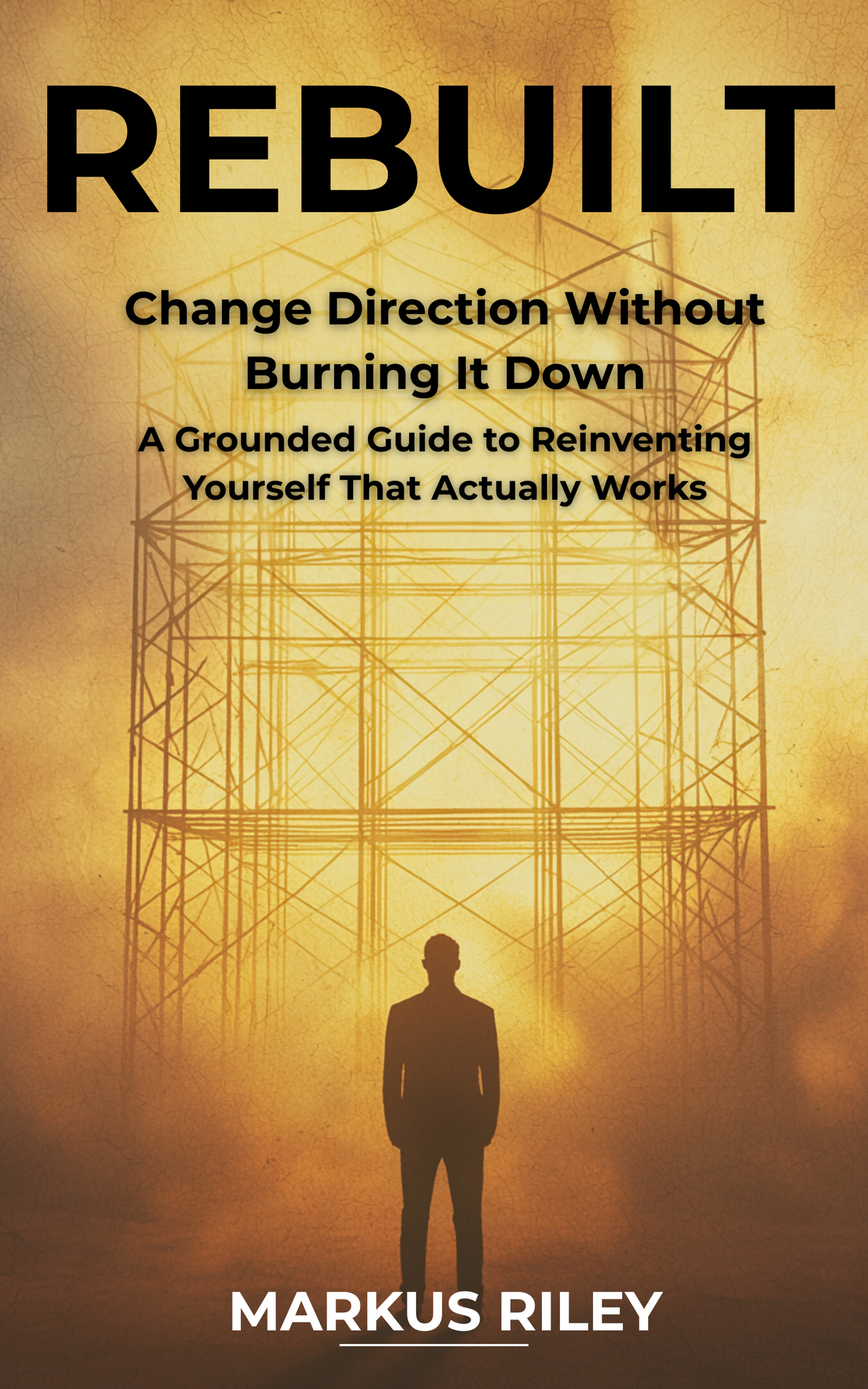
REBUILT is the practical, research-backed guide to reinventing yourself you've already built — without blowing up your finances, your relationships, or everything
THE PROBLEM
You've been waiting for the right moment. It isn't coming.
Maybe you've known for a year. Maybe it's been longer. There's a version of your life that makes sense — a different kind of work, a different direction, a truer fit between who you actually are and how you spend your days. You can picture it clearly.
And yet.
The mortgage is real. The obligations are real. The people depending on you are real. So you wait. You plan. You tell yourself you're being responsible.
But somewhere underneath all that sensible caution is a quieter truth you haven't quite faced yet:
Staying put isn't actually the safe option. It just feels like one.
The cost of a misaligned life doesn't arrive as a crisis. It shows up as a low-grade flatness. A slow, creeping sense that the person you've become is a performance you no longer believe in. Competent. Reliable. Checked out.
That's not stability. That's stagnation with a good cover story.
THE REFRAME:
You're not afraid of change. You're afraid of doing it wrong.
Most reinvention advice assumes the hard part is deciding to go. It isn't. The hard part is everything that comes after — the months where nothing is certain, the attempts that don't land, the people around you who think you've lost your mind, and the moments when your own brain quietly convinces you to quit.
Your brain, it turns out, is working against you. Not out of malice — out of efficiency. When effort doesn't produce immediate results, a specific neurological mechanism suppresses your motivation to keep trying. Researchers call it the lateral habenula. Most people just call it giving up.
Reinvention doesn't fail because people lack courage.
It fails because nobody explains what's happening inside your head — and what to do about it.
WHAT REBUILT IS:
Not a pep talk. Not a vision board exercise. A complete operational guide.
REBUILT is written for people with real lives, real financial obligations, and real relationships they're not willing to sacrifice in the name of personal growth. It's grounded in behavioral research and neuroscience — not motivational abstraction.
IIt takes seriously the fact that meaningful change is hard. Not because you're doing something wrong. Because your brain, your identity, and most of the people around you are — by default — working against it.
What you'll find in these pages is a practical framework for changing direction without starting from scratch. Step by step. Evidence-based. Built for the version of reinvention that most books are too optimistic to describe honestly — the real one, with the messy middle include
WHAT'S INSIDE
9 Chapters. One Complete Framework for Reinventing Without the Wreckage.
Chapter 1 — The Hidden Cost of Standing Still
Staying put feels safe. It isn't. This chapter makes the real cost of a misaligned life visible, measurable, and impossible to keep rationalizing — through the Alignment Audit that shows you exactly where the gaps are.
Chapter 2 — How Your Brain Works Against You
The lateral habenula. The failure loop. The way three or four small setbacks can quietly kill motivation that felt completely real a week ago. Understanding this mechanism is the first step to overriding it.
Chapter 3 — The Iterative Mindset
Grand plans are brittle. Small experiments are durable. This chapter shows you how to treat your life as a laboratory — running 90-day viability tests instead of making decade-long bets on imperfect information.
Chapter 4 —Protecting Who You Are
When one professional role becomes your entire identity, threatening the role feels like threatening the person. Here's how to build a self- concept resilient enough to survive a real transition — and expand rather than collapse under the pressure.
Chapter 5 — Building the Bridge
How to move toward what you want using what you already have — your existing skills, your existing network, your existing credibility. The bridge strategy produces more durable transitions than starting from zero.
Chapter 6 — Redesigning Your Character:
Personality isn't fixed. Research shows it can be changed deliberately — through targeted behavioral effort, practiced at the right frequency. This chapter gives you the specific framework to develop exactly the traits your next chapter requires.
Chapter 7 — Using Technology as a Learning Accelerator
AI tools, used well, can compress a learning gap that used to take years into a matter of weeks. This isn't about gimmicks. It's a practical, judgment-based approach to leveling the playing field for career changers at any age and any starting point.
Chapter 8 — Navigating the Messy Middle:
The stretch between deciding to change and actually arriving somewhere new. The identity limbo. The financial pressure. The abort impulse that feels like wisdom but is usually just fatigue. This chapter is the one most books skip entirely.
Chapter 9 — Staying Grounded in a Volatile World:
How to sustain momentum over the months and years reinvention actually takes — managing other people's skepticism, building non- reactive engagement, and constructing the resilience infrastructure before you need it.
THIS IS FOR YOU IF...
✔ You know something needs to change — but you can't afford to blow everything up to make it happen
✔ You've started before and stalled out, and you're done blaming yourself for it
✔ You're smart enough to see through the usual motivation content, but still haven't moved
✔ You want to understand what's actually happening — not just be told to believe in yourself
✔ You're somewhere in the middle of a transition that's harder and lonelier than you expected
✔ You want a complete framework, not a single idea wrapped in 200 pages of filler
WHAT CHANGES
By the time you finish REBUILT, you'll:
✅ Understand the real neurological reason your motivation keeps dying — and know exactly how to disrupt the pattern
✅ Have a clear, honest picture of where the gaps are in your current life — and what they're actually costing you
✅ Know how to run a 90-day experiment that replaces speculation with real data
✅ Have a resilient, multi-anchored identity that doesn't collapse under the pressure of a real transition
✅ Know how to use the skills and credibility you already have as a bridge to where you want to go
✅ Have a practical system for navigating the messy middle — the financial pressure, the identity limbo, the abort impulse
✅ Be building deliberately toward the traits your next chapter requires — not waiting for them to show up on their own
STRAIGHT ANSWERS TO FAIR QUESTIONS
I've tried reinvention before and it didn't stick.That's not a character flaw — it's a predictable outcome when nobody explains how the brain undermines motivation during exactly this kind of transition. REBUILT starts there, because that's where most attempts actually break down.
I can't afford to take risks right now." "Good because this framework is specifically designed for people who can't. You'll learn the bridge strategy: how to move toward what you want using what you already have, without requiring a crisis to get started.
Is this going to be full of jargon and lab results I can't use? No. Every concept in this book connects directly to something you can do this week, with the time and resources you already have. The research is real. It reads like a conversation.
How long will this take to read?
It's a weekend book. You can run the first exercise — the Alignment Audit — today.
You don't need a rock bottom. You just need a starting point.
Most people who are stuck already know they're stuck. They can
describe the problem clearly. They can picture a better version of their life. And then they don't move.
Not because they lack courage. Because the transition is genuinely hard, and nobody gave them a complete picture of what it actually involves..
REBUILT is that picture. The real costs of standing still. The
neuroscience of why momentum dies. The framework for changing direction without burning anything down. The guide to the messy middle that everyone goes through and nobody talks about.
It's all here. You don't need to wait for a better moment.
30-Day Quality Guarantee
This guide contains comprehensive, evidence-based strategies for systematic personal development.
If you feel the content doesn't deliver valuable, actionable frameworks as described, contact us within 30 days.
.
.